
The AI Judgment Gap: Why AI Governance Is So Important for Mission-Driven Work
AI is in your organization today, every platform, every model, running against organizational and donor data.
Almost everyone is using AI today, and not just for travel planning, or recipes, or personal finances; people are using AI at work and for work, and not only the people who work in software. There, I said it; it needed to be said. We all do it.
And that's a good thing. In today's world of too much data and not enough time, AI can drastically improve research, decision making, and focus. The flip side of that coin is that it can just as drastically harm research, decision making, and focus. A bad AI engagement in a mission-driven organization can go so far as to jeopardize critical, private donor and service-user data. And the worst part isn't necessarily the impact; it's the risk you're running by not knowing who is doing what. It's the quintessential "risk of the unknown."
Some of your staff have been open about their AI use, and it usually surfaces in one of two moments: when something impressive lands ("That's incredible! How did you do that so quickly?"), or when something a bit shady does ("Look at this image we created of us at a convention we couldn't afford to attend in person!"). And why wouldn't they? The barrier to entry for consumer AI tools is extremely low: pass in a small amount of background ("context"), ask your question or give it a direction, and immediately see results. It's dreamy, and it's too tempting not to use it.
Regardless of how you gain visibility into your org's day-to-day AI usage, unless your AI policy is firmly anti-AI (which is totally fine), supporting your staff's experimentation is a good way to engage them on approved usage of AI. These examples of employees moving forward on their own highlight the root cause:
A lack of governance and policy on how to engage with AI at the employee level.
More proof comes from the pointed questions your employees ask:
Can we even use AI for work?
What should I not do with AI at work?
Do we have internal AI tools that are approved for use?
Can I use AI to analyze donor data?
Is it OK to create marketing images for our website or email communications with AI?
Do I need to disclose that I used AI internally, externally, or both?
Worst case, though: they aren't asking these questions at all, and are using AI on their own without any visibility.
The Judgment Gap
This behavior points to a core problem plaguing many mission-driven organizations: no strong AI usage guidelines from the top, coupled with rampant AI usage within the org. The AI Judgment Gap.
The AI Judgment Gap is the delta between what's happening in the organization for day-to-day operations, and the existence or absence of an official AI policy.
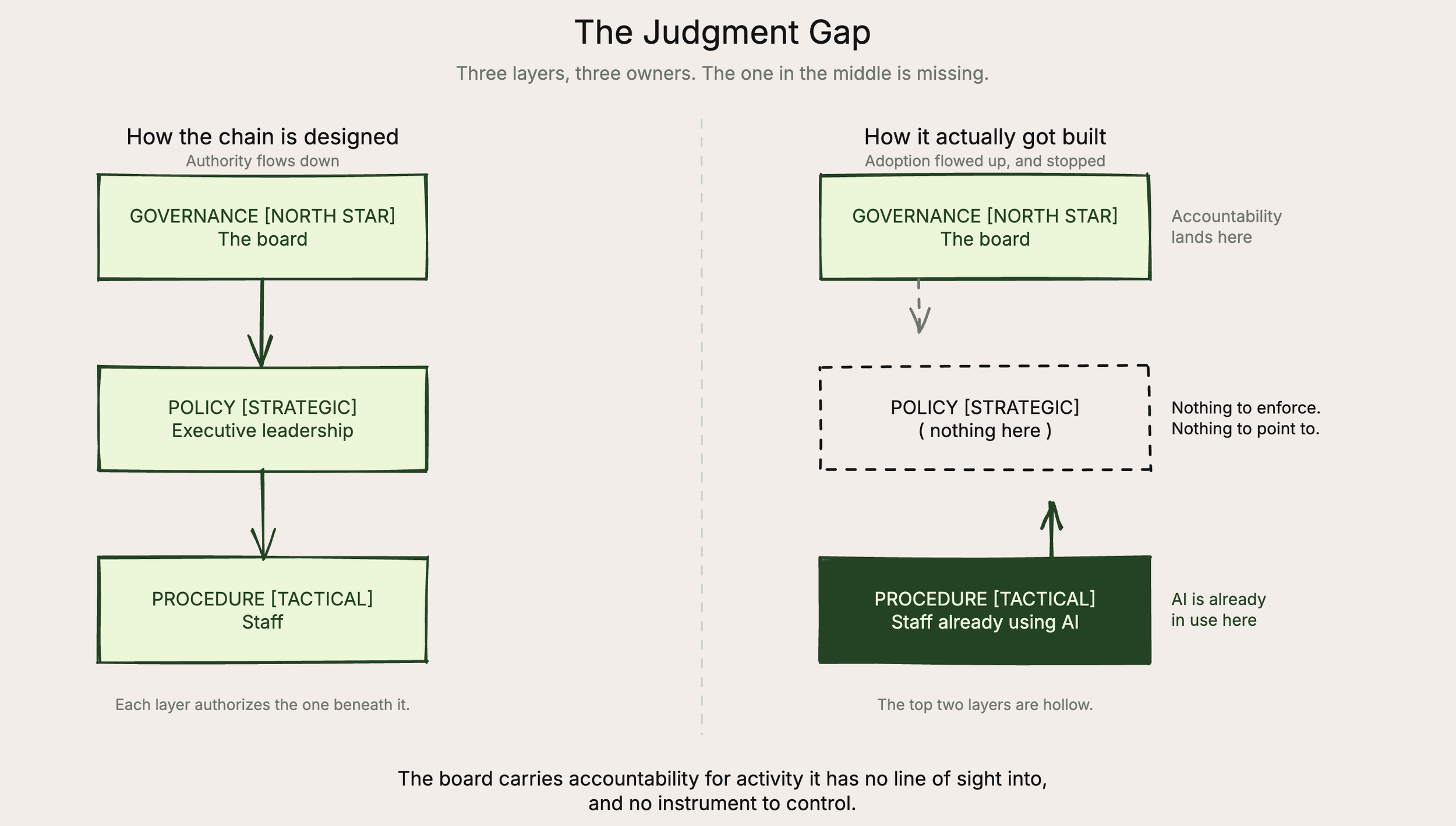
The Judgment Gap
Like any good project implementation, the best place to start before doing any work is a gap analysis: where are you in practice today, where do you aspire to be tomorrow, and do you have a plan to get there? The questions your staff is asking above are the best place to start analyzing the AI Judgment Gap. They help surface the business need for AI, and the areas where staff need access to shared data, while you, the executive leader, drive the approved AI usage policy against those business goals and needs.
| AI Surface Area | Ownership | Implementation |
|---|---|---|
| Governance [NORTH STAR] | The board | Sets and guides the governance plan: the direction and guidance for acceptable AI usage. |
| Policy [STRATEGIC] | Executive leadership | Applies and manages the board's direction through policy. |
| Procedure [TACTICAL] | Staff | Adheres to and implements the organization's AI policy. |
Narrowing the Judgment Gap is a north star, strategic, and tactical benefit, all in one.
The Judgment Gap defines where the gaps in this process sit within the organization, and most importantly, how to address them. Every organization is different; there is no cookie-cutter right answer to fill the Judgment Gap, and no adoption plan that works for every organization. Instead, the executive leadership team, which knows the most about the organization's culture, operations, and goals, becomes both the guide and the arbiter of closing the AI Judgment Gap in a way that best fits the organization.
Regardless of the organization type, rolling out an acceptable and successful AI policy has to happen in partnership between the board, executive leadership, and staff. If any of these groups is under-represented, or fails to implement its portion of filling the Judgment Gap, the issues get re-analyzed and the existing gaps get re-identified and addressed. That's the beauty of treating AI policy as a process rather than something set in stone that becomes unchanging gospel.
Looking for a quick way to run an AI Judgment Gap analysis? Check out Lansby's AI Readiness Guide for a self-evaluation on where you and your organization stand.
Did we use AI for this post? Written by Alan Murphy, copyedited for grammar, flow, and story by Claude Code claude-opus-5.
